How Hormone Replacement Therapy (HRT) Helps Prevent Osteoporosis
Dr. Matthew Lewis
HRT, Osteoporosis, Hormone Replacement Therapy

As a seasoned holistic and functional medicine provider, I’ve been seeing patients for over twenty years. I've mixed feelings about the current conversation around hormone replacement therapy (HRT) for women, especially when it comes to women dealing with osteoporosis.
If you haven’t heard the recent news, the black box warning on hormone therapy has officially been removed.
For those of us in holistic medicine, this moment is a bit bittersweet. The reality is that many functional medicine doctors were already sharing the benefits with patients years ago. Unfortunately, this information was often dismissed, criticized, or even ridiculed by conventional medicine. Thankfully, it has now been validated.
It's a shame that many women were caught in the middle of that confusion. Many patients were left fearful of hormones and stuck within a conventional system that often dismissed their symptoms or concerns.
In this article, I'll walk you through the difference between conventional hormone replacement therapy and bioidentical hormone therapy, and explain why this distinction matters, particularly when it comes to bone health and osteoporosis prevention.
My goal is simple: to help women make informed decisions about their bodies and their long-term health.
The Critical Role Hormones Play in Bone Health
We know that estrogen has a big role in helping a woman's body maintain healthy bone density. That's the reason bone loss accelerates when women's estrogen levels decline during menopause.
Without the right hormonal support, women face significantly higher risks of:
Osteoporosis
Bone fractures
Loss of muscle mass
Chronic inflammation
Declining metabolic health
Fractures related to osteoporosis are one of the leading contributors to disability and mortality among older women.
When hormone replacement therapy is done correctly, it can play a powerful role in protecting bone health.
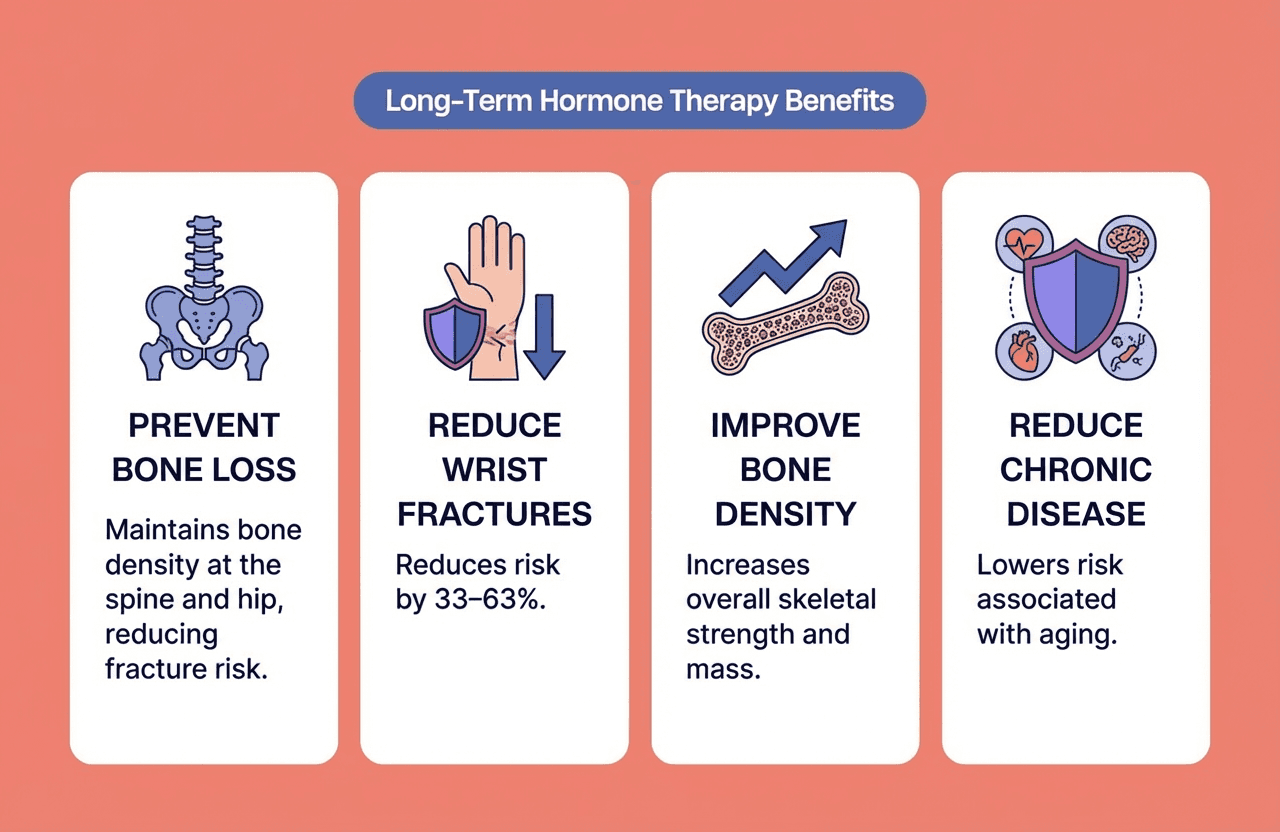
Research shows that long-term hormone therapy can:
Prevent bone loss at the spine and hip
Reduce wrist fracture risk by 33–63%
Improve overall bone density
Reduce chronic disease risk associated with aging
What Caused Conventional Medicine's Fear of HRT?
Much of the fear surrounding hormone replacement therapy started with the Women’s Health Initiative (WHI) clinical trials.
Between 1993 and 1998, the WHI enrolled 27,347 postmenopausal women aged 50–79 to evaluate the risks and benefits of hormone therapy in a long-term clinical trial.
The trial was terminated early after researchers reported increased risks of breast cancer, blood clots, and stroke.
This caused panic, and the medical community reacted quickly and dramatically to this study. Even though hormone therapy had been widely used for decades, it practically disappeared from clinical practice overnight.
But over time, researchers began to realize that the problem was not hormone therapy itself. The problem was actually the type of hormones used in the study.
What Was The Problem With Conventional Hormone Replacement?
You may be thinking, wait a second, if hormones are causing breast cancer and embolisms, a good choice was made here to protect women.
But of course, there is more to the story. The increase in breast cancer, along with embolisms, was a sign that doctors were not wrong in providing hormones to their patients, but were misled by the pharmaceutical industry, which once again provided the more “toxic” approach to medicine.
The pharmaceutical industry used estrogen from horses and synthetically derived progestins. This is not the same estrogen or progesterone naturally occurring in a woman’s body.
Research now shows that synthetic progestins can:
Upregulate inflammatory pathways
Increase certain cancer risks
Disrupt normal hormone metabolism
Additionally, horse-derived estrogen is metabolized more heavily into estrone, a form of estrogen associated with increased breast cancer risk.
Despite these issues, even the WHI trials demonstrated that hormone therapy improved:
Bone density
Coronary heart disease markers
Diabetes risk markers
This tells us something very important: women need estrogen for optimal health.
The Rise of Bioidentical Hormone Replacement Therapy (BHRT)
Throughout many decades, including the 80’s, 90’s, and 2000’s, clinical data was emerging on both the availability and benefits of bioidentical hormones, and many practitioners began exploring bioidentical hormone replacement therapy (BHRT).
Unlike pharmaceutical hormone products, bioidentical hormones are typically created through compounding pharmacies and often derived from plant sources such as wild yam.
These hormones are formulated to replicate the body's natural estrogen and progesterone.
Key benefits of bioidentical hormones include:
Lower inflammatory impact
Improved metabolic compatibility
More personalized dosing
Reduced risk compared to synthetic progestins
During this time, holistic practices across the country were helping women who chose not to go without hormone treatments. These women were sick of hot flashes, night sweats, moodiness, irritability, pain, brain fog, vaginal dryness, hair loss, and the many other internal problems, like bone density loss, that they were experiencing.
The Effects of Fear Around Hormone Therapy
This is where holistic doctors become frustrated.
After the Women’s Health Initiative trials, a strong wave of fear surrounding hormone replacement therapy spread throughout the medical community and the public. Women were told hormones were dangerous, and many stopped using them altogether.
During this same time, pharmaceutical and conventional healthcare systems shifted toward other treatments, many of which generated billions of dollars but often produced far less effective results compared to properly administered hormone therapy.
So what happened during those decades?
Breast cancer initially declined for women who stopped using the horse-derived hormones used in earlier therapies, along with improvements in screening practices. However, today we are seeing breast cancer rates steadily rising again, along with a growing number of chronic inflammatory conditions associated with aging, sometimes referred to as “inflammaging.”
At the same time, osteoporosis has increased dramatically, largely due to decades of hormone avoidance.
Potential Benefits of Bioidentical HRT
If each patient is treated based on their unique needs and they are monitored appropriately, bioidentical hormone therapy can provide a wide range of benefits for women during perimenopause and menopause to help slow or prevent osteoporosis.
Many women report improvements in:
Skin, hair, and nail health
Mood and cognitive clarity
Sleep quality
Bone density
Inflammatory markers
Blood sugar regulation
Heart health
Libido and vaginal dryness
Immune function
For women struggling with symptoms like hot flashes, brain fog, mood changes, and bone loss, hormone replacement therapy (HRT) can often be life-changing.
Why Timing Is Important With HRT and Menopause
One of the key insights emerging from modern research is something called the timing hypothesis.
It's been noted that women who begin hormone therapy earlier, during perimenopause or within the first several years of menopause, often experience the greatest protective benefits.
These benefits may include improvements in:
Bone density
Brain aging
Heart health
Overall quality of life
That said, women in their sixties or seventies who have never started therapy may still benefit in certain cases. Each patient needs to be evaluated individually.
A Holistic Approach to Hormone Therapy
At Provoke Health, we offer a holistic approach to bioidentical hormone replacement therapy (BHRT).
Each patient we see receives a personalized evaluation and workup before we make any changes.
Instead, we evaluate the entire hormonal and metabolic picture.
This includes analyzing:
Female hormone levels
Thyroid function
Cortisol and adrenal health
Inflammatory markers
Lipid profiles
Vitamin and nutrient levels
We also review family history and genetics when appropriate.
For patients concerned about cancer risk, additional testing options may be considered, including:
BRCA genetic testing through the Myriad panel
Multi-cancer early detection testing, such as the Galleri test
These tests are not necessary for every patient, but they can provide additional insight when clinically appropriate.
Once therapy begins, patients are monitored closely with follow-ups at 60 days and then quarterly during the first year to ensure optimal outcomes.
Schedule Your Consultation
If you are experiencing symptoms of menopause or are concerned about osteoporosis and long-term bone health, we invite you to explore your options.
At Provoke Health, we offer a holistic approach to Bio-Identical Hormone Replacement.
This means you will receive:
Bio-identical hormones personalized to your needs from a trusted compounding pharmacy. (This greatly reduces the previous risks associated with HRT)
Individualized attention to the details in your labs, including vitamin markers, inflammatory markers, lipid profiles, female hormones, thyroid, and cortisol. This helps us to provide a more holistic view of what is needed when optimizing hormones.
Individualized attention to your genetics and family history. There are several options for testing if there are any concerns for cancer risk, including genetic BRCA testing using the Myriad Test and or the Galleri test. These tests are not needed for all patients and can be used for those who would benefit from knowing more about potential risk.
Once therapy with Bio-identical hormones, patients are monitored for sixty days and then quarterly for the first year. Adjustments are made as needed to ensure the patient is receiving the best possible outcome.
If you are ready to start feeling better and want a more holistic approach to your healthcare, schedule your a free 15-minute consultation and start your healing journey with Provoke Health.
About the Author: Dr. Matt Lewis, D.C., DACBN, CFMP®, specializes in diagnosing and treating the underlying causes of the symptoms related to chronic and unexplained illness through nutrition, lifestyle, chiropractic, and other natural approaches to whole-health healing in Tampa, Florida. He earned his B.S. in Biology from Shenandoah University, his Doctorate in Chiropractic from Life University, his Diplomate status in Clinical Nutrition from the American Clinical Board of Nutrition, his CFMP® from Functional Medicine University, and his certification as a Digestive Health Specialist (DHS) through the Food Enzyme Institute. Dr. Lewis’ passion for health and wellness stems from his own personal experience. With a family history of autoimmune conditions and diabetes, and his own lab tests showing his genetic susceptibility to Hashimoto’s thyroiditis (autoimmune thyroid), he has learned how to restore his own health and vigor to prevent the onset of these and other illnesses and live an incredibly active life. Through this process, he acquired a deeper understanding of health and wellness, which he now offers his patients in Tampa.
Article references:
Eastell R, Rosen CJ, Black DM, et al. Pharmacological Management of Osteoporosis in Postmenopausal Women: An Endocrine Society Clinical Practice Guideline. J Clin Endocrinol Metab. 2019;104(5):1595-1622.
Gosset A, Pouillès JM, Trémollieres F. Menopausal Hormone Therapy for the Management of Osteoporosis. Best Pract Res Clin Endocrinol Metab. 2021;35(6):101551.
Gartlehner G, Patel SV, Reddy S, et al. Hormone Therapy for the Primary Prevention of Chronic Conditions in Postmenopausal Persons: Updated Evidence Report and Systematic Review for the US Preventive Services Task Force. JAMA. 2022;328(17):1747-1765.
US Preventive Services Task Force, Mangione CM, Barry MJ, et al. Hormone Therapy for the Primary Prevention of Chronic Conditions in Postmenopausal Persons: US Preventive Services Task Force Recommendation Statement. JAMA. 2022;328(17):1740-1746.
Manson JE, Crandall CJ, Rossouw JE, et al. The Women's Health Initiative Randomized Trials and Clinical Practice: A Review. JAMA. 2024;331(20):1748-1760.
Rossouw JE, Aragaki AK, Manson JE, et al. Menopausal Hormone Therapy and Cardiovascular Diseases in Women With Vasomotor Symptoms: A Secondary Analysis of the Women's Health Initiative Randomized Clinical Trials. JAMA Intern Med. 2025;185(11):1330-1339.
Manson JE, Aragaki AK, Rossouw JE, et al. Menopausal Hormone Therapy and Long-Term All-Cause and Cause-Specific Mortality: The Women's Health Initiative Randomized Trials. JAMA. 2017;318(10):927-938.
LaMonte MJ, Manson JE, Anderson GL, et al. Contributions of the Women's Health Initiative to Cardiovascular Research: JACC State-of-the-Art Review. J Am Coll Cardiol. 2022;80(3):256-275.
Mohammed K, Abu Dabrh AM, Benkhadra K, et al. Oral vs Transdermal Estrogen Therapy and Vascular Events: A Systematic Review and Meta-Analysis. J Clin Endocrinol Metab. 2015;100(11):4012-20.
Postmenopausal Estrogen Therapy: Route of Administration and Risk of Venous Thromboembolism. 2019.
Prior JC. Progesterone or Progestin as Menopausal Ovarian Hormone Therapy: Recent Physiology-Based Clinical Evidence. Curr Opin Endocrinol Diabetes Obes. 2015;22(6):495-501.
Bofill Rodriguez M, Yong LN, Mirkov S, et al. Long-Term Hormone Therapy for Perimenopausal and Postmenopausal Women. Cochrane Database Syst Rev. 2025;11:CD004143.
Clemons M, Goss P. Estrogen and the Risk of Breast Cancer. N Engl J Med. 2001;344(4):276-85.
Gompel A, Simcock R. Menopausal Hormone Treatment and Breast Cancer. Lancet Diabetes Endocrinol. 2026;S2213-8587(25)00394-8.
Fournier A, Berrino F, Riboli E, Avenel V, Clavel-Chapelon F. Breast Cancer Risk in Relation to Different Types of Hormone Replacement Therapy in the E3n-Epic Cohort. Int J Cancer. 2005;114(3):448-54.
Abenhaim HA, Suissa S, Azoulay L, et al. Menopausal Hormone Therapy Formulation and Breast Cancer Risk. Obstet Gynecol. 2022;139(6):1103-1110.
Finlay-Schultz J, Gillen AE, Brechbuhl HM, et al. Breast Cancer Suppression by Progesterone Receptors Is Mediated by Their Modulation of Estrogen Receptors and RNA Polymerase III. Cancer Res. 2017;77(18):4934-4946.
Kester HA, van der Leede BM, van der Saag PT, van der Burg B. Novel Progesterone Target Genes Identified by an Improved Differential Display Technique Suggest That Progestin-Induced Growth Inhibition of Breast Cancer Cells Coincides With Enhancement of Differentiation. J Biol Chem. 1997;272(26):16637-43.
Trabert B, Bauer DC, Buist DSM, et al. Association of Circulating Progesterone With Breast Cancer Risk Among Postmenopausal Women. JAMA Netw Open. 2020;3(4):e203645.
Trabert B, Sherman ME, Kannan N, Stanczyk FZ. Progesterone and Breast Cancer. Endocr Rev. 2020;41(2):bnz001.
Lundell C, Stergiopoulos N, Blomberg L, et al. Breast and Endometrial Safety of Micronised Progesterone Versus Norethisterone Acetate in Menopausal Hormone Therapy (PROBES): Study Protocol of a Double-Blind Randomised Controlled Trial. BMJ Open. 2024;14(10):e082749.
Gladys Arias, Steve Bouvier, Christy Cushing, et al. Breast Cancer Facts & Figures. 2025.
Chlebowski RT, Aragaki AK. Long-Term Breast Cancer Incidence Trends by Mammography, Obesity, and Menopausal Hormone Therapy. Breast Cancer Res Treat. 2024;203(1):121-124.
Naso CM, Lin SY, Song G, Xue H. Time Trend Analysis of Osteoporosis Prevalence Among Adults 50 years of Age and Older in the USA, 2005-2018. Osteoporos Int. 2025;36(3):547-554.
Curry SJ, Krist AH, Owens DK, et al. Screening for Osteoporosis to Prevent Fractures: US Preventive Services Task Force Recommendation Statement. JAMA. 2018;319(24):2521-2531.
Harris K, Zagar CA, Lawrence KV. Osteoporosis: Common Questions and Answers. Am Fam Physician. 2023;107(3):238-246.